Reflections on Creating the Solo Exhibit, Poiema, Mortality and Resurrection

In one of Rainer Maria Rilke’s letters to his wife he remarks about art: “Surely all art is the result of one’s having been in danger, of having gone through an experience all the way to the end, to where no one can go any further. The further one goes, the more private, the more personal, the more singular an experience becomes, and the thing one is making is, finally, the necessary, irrepressible, and as nearly as possible, definitive utterance of this singularity… Therein lies the enormous aid the work of art brings to the life of the one who must make it, that it is his epitome; the knot in the rosary at which his life recites a prayer, the ever-returning proof to himself of his unity and genuineness, which presents itself only to him while appearing anonymous to the outside, nameless, existing merely as necessity, as reality, as being-” (Letters on Cezanne, translated by Joel Agee, Fromm International Publishing Corporation, New York, 1985)

This quote resonated with me when I read it. My most recent solo exhibit closed at the end of October, and as I was driving home with the paintings, I reflected on my experience creating a body of work that had a deeper meaning to me personally than anything else I had done in the past. Poiema, Mortality and Resurrection is a series of paintings that explores themes of death, decay and new life as is experienced in the flora and fauna of the changing seasons. Juxtaposed to watercolor paintings are eggshells painted in acrylics, further illustrating the change of the seasons and the marching on of life. The paintings are accompanied by excerpts of poetry from Rainer Maria Rilke, David the Psalmist, the Anglo-Saxons and more.
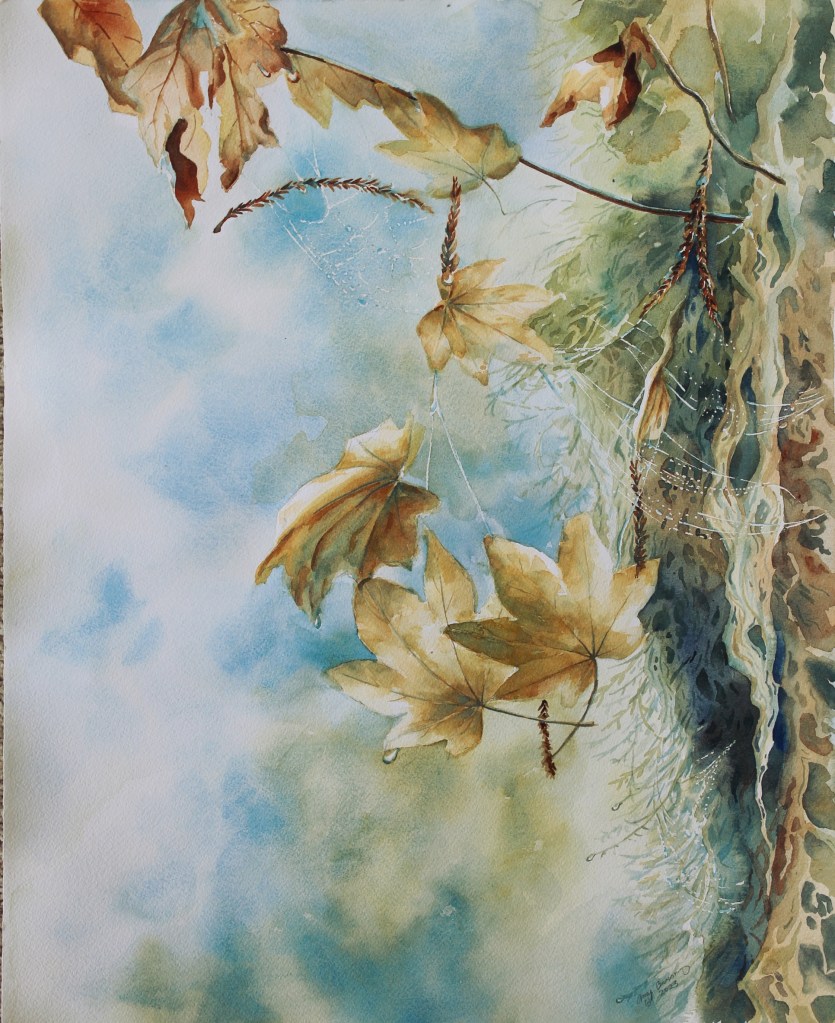
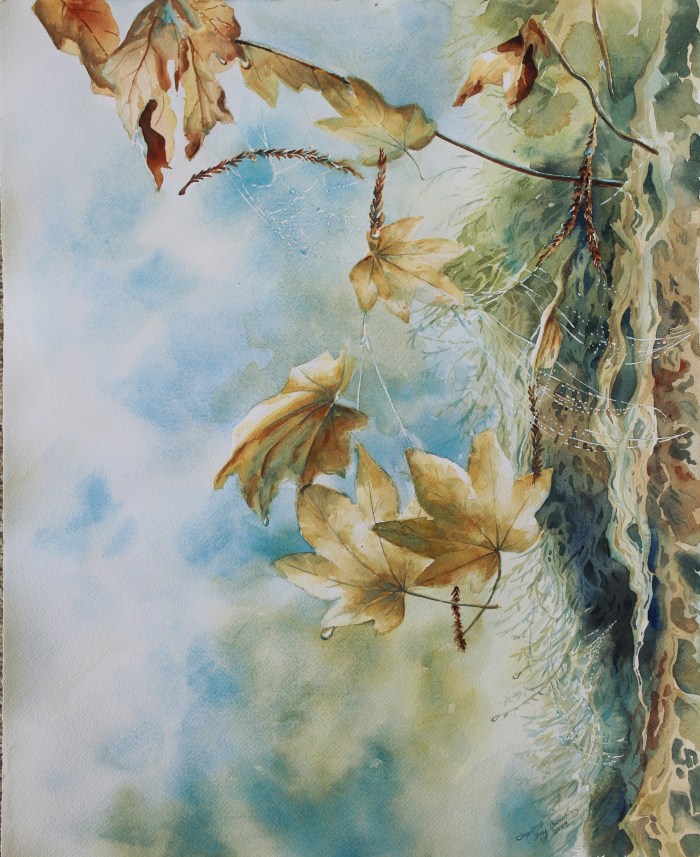
“Leaves Fallow and Softly Fall” Watercolor painting inspired by the Old English word “fallow” and Rilke’s poem, “Herbst” (Autumn).

The seeds of the concept for this series sprouted four years before, after a time when I was in danger, but until last year, I was hesitant to bring it to completion. This was for two reasons. One was that I had to deeply contemplate my own mortality in the process of creating it, and the other was I had to be open to sharing my personal beliefs about life, death and the resurrection. I believe the fear of being rejected is so much worse when you’re sharing a private aspect of yourself with the world. I had, however, heard it again and again from artists and actors that you should create work that is meaningful to you personally and it will also be meaningful to those who see it. This was my attempt at doing so, and why I encourage other artists to do the same.

This body of work was one where I drew from many creative sources for inspiration. Early on, I decided the paintings would be inspired by poetry after discovering Rilke’s poem, “Autumn”, and his description of Autumn that he wrote to his wife in his Letters on Cezanne. I later discovered a whole slew of Anglo Saxon poetry that highlighted life and resurrection in Winters in the World by Eleanor Parker, which ended up being my biggest resource. Basing a series around poetry forced me to read more than I have in nearly 20 years. I read Shakespeare’s sonnets, William Blake, the Psalms of David and Solomon, and others in an attempt to find poetry that would put into words what I wanted to express in images. Allowing poets to inspire me was like having a conversation with those poets across time. It was nourishing and rewarding to my artist soul.

“The Quickening of the Trees” Watercolor painting inspired by an Anglo-Saxon poem comparing the quickening of the trees with the resurrection of the dead at the end of time.

While I was painting, I contemplated a lot about life and purpose. I often weigh the importance of what I am making with my overall purpose, which is, frankly, raising my children and caring for the people around me. Is what I am making worth my time spent alone? Am I doing it to benefit my soul or others or is it for vainglory? (I admit having had created work for vainglory, and it wasn’t spiritually fulfilling. It’s a constant struggle as an artist. To clarify, creating for vainglory is different than creating for income.) As I was working on Poiema, Mortality and Resurrection, my work became both a meditation on life and mortality and oftentimes a prayer. Working on the paintings in the early morning hours before the household awoke helped me to organize my thoughts before starting the day. As I was creating the work, I thought that it didn’t matter as much if they’re seen by many people, because the act of painting changed me personally. I realized that this is one of the reasons to create what is important to you. Even if your work is not seen by many, you personally gain something from it. Rilke’s quote reminded me of my own experience: “Therein lies the enormous aid the work of art brings to the life of the one who must make it, that it is his epitome; the knot in the rosary at which his life recites a prayer”.
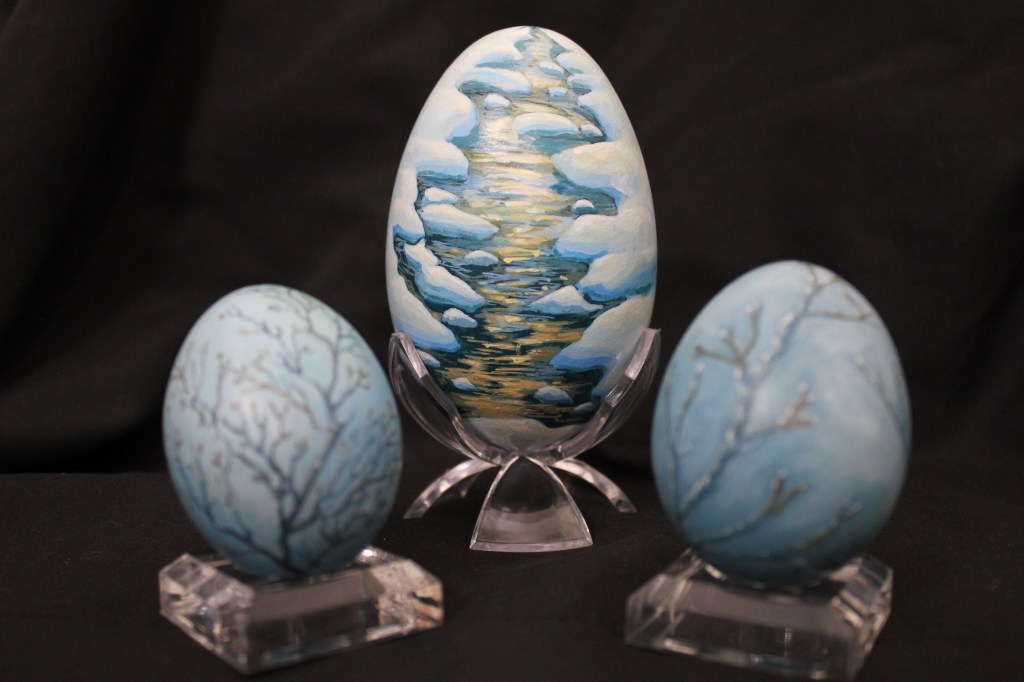
“Dormant”, “Unwind the Water’s Chains” and “Bone-Brittle Branches” Acrylic on Eggshells

In the end, I believe those who had said that if you connect with an idea, others will too, were correct. I kept a notebook with my paintings where visitors could comment on the exhibit. I had some write that they connected with the eggshells, because it reminded them of their childhood and family from Eastern Europe. Others wrote comments that made me realize they found the exhibit meaningful in other ways. This was my desire for this exhibit and knowing that others found it meaningful made it all the more meaningful to me. I hope to keep this in mind as I choose my projects in the future. Time is precious. It could either be spent trying to impress others and make yourself into what others think you should be, or being authentic in the projects you choose to work on, seeking what is true and benefiting yourself spiritually as well as others who see your work.
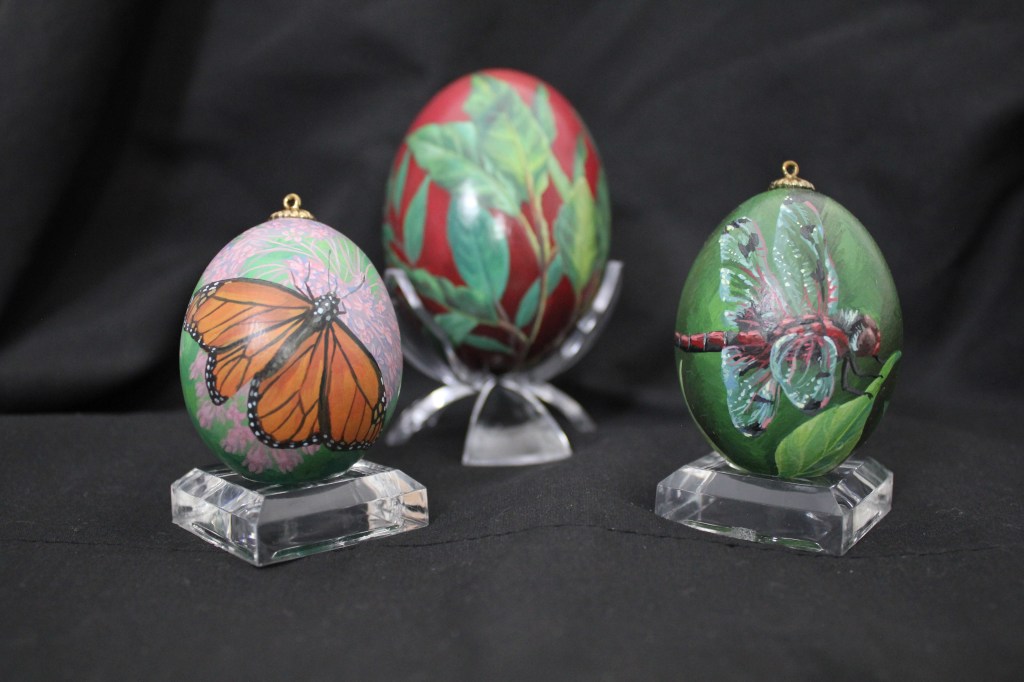
“Monarch”, “Victory”, and “Red Dragonfly – Harbinger of Life” Acrylic on Eggshells

Creating a Body of Work, one hour at a time

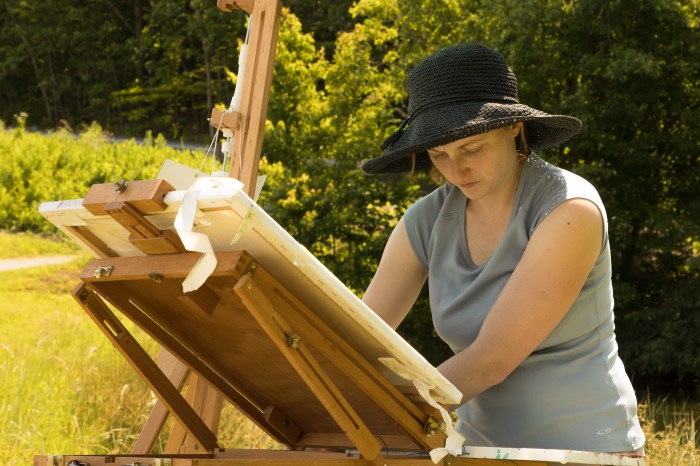
People who know me personally know I have three children whom I educate at home, that I teach German language and art classes outside the home, and I coach weekly youth soccer in the fall. I’m often asked how I have time to paint. The truth is it’s challenging to find the time, especially since the pandemic ended and life has become normal again, but painting is important to me, so I find the time or I make it. I write this as I hope it’s inspiring to any other artists or writers out there who have had an artistic idea they wanted to execute but just didn’t know how to fit it into their schedules.

A daily art routine has been part of my schedule for 11 years now. When my first child was born, I wanted to make sure I kept painting so I wouldn’t lose the skills I had learned, so I set aside an hour every afternoon while she was napping. I kept the baby monitor in the room where I painted to listen for her to wake up. I had given up oil painting when I learned I was expecting her, and decided to focus solely on watercolor, because there are no fumes, and I could leave it at a moment’s notice without much cleanup and return to the painting later. I had grown up painting watercolor at our dining room table, so I knew I could do it anywhere.

I continued this daily routine of painting during nap time throughout my children’s toddler years. Painting was not just work for me, but a way for me to refresh my mind before the evening rush of making dinner and putting the kids to bed. I’m an introvert, like so many artists, so I desperately need time to myself every day to be able to function around people.

Skip to the pandemic. Our weekly schedule of co-op classes twice a week and evening activities was halted. We were at home with each other all day. I instructed the children in their school subjects from 9 am to 3 pm. We weren’t seeing friends, so we entertained each other during our lunch hour, playing theatre games and making each other laugh. I needed my painting time even more during that period, so I would let them watch television for an hour in the afternoons so I could paint and be refreshed. During that year (the Fall of 2020) I landed my solo exhibit. I had painted 5 paintings to apply for it, but would only use 3 of them, and I had a year and a half to paint and sculpt the rest.

As 2021 rolled around, our outside activities started to pick up again, so I needed to adjust my painting schedule to make sure I had enough time to finish all the paintings I had in mind. I was still homeschooling, so I needed to work in my painting time around the time I was teaching. I started waking at 5:00 am every morning to get about 2 hours of painting in before the children awoke. At first it was hard to wake up that early, but then I started to really appreciate my mornings. It was enjoyable watching the sky blush pink and listening to the morning chorus of birds while I sipped coffee, listened to classical music, and painted. Spending these two hours in the morning by myself energized me for exerting my social energy with my kids the rest of the day. Some days I was lucky and got an addition hour or two in the afternoon if everyone finished their school on time.

Of course, I couldn’t get the entire solo exhibit painted in only a year and a half with only 2-3 hours a day. A few times on the weekends my husband took the kids to the park or a party for part of the day and I got 4-5 hours in. Twice I had a friend come over during the week with her child to watch the children while they all played together, and I painted. During the summer of 2021, when the kids were out of school, I painted the entire morning and took them to the outdoor pool for the afternoon. We had a blast that summer at the pool.

I’m sure this sounds exhausting. It was. One can’t continue at this pace without rest. I realized this, so I made sure I slept in until 8:00 am at least once a week, usually on Sundays. I also decided not to do any painting on Sundays, either. If I had time in the afternoon, I spent it outdoors in nature. Being in nature is as important to me as painting, and a vital part of the inspiration for my paintings. Every few weeks when I had finished a painting, I would give myself a few extra days to sleep in until 7:00 am.

Now with that body of work completed and coming up on one year since the solo exhibit, I have thought about my practice of painting 1-2 hours a day and how to keep that going without burning out. It took me a couple months to recover after the solo exhibit was installed. I no longer wake at 5:00 every morning but have found 6:00 a more reasonable time for me. Here are some suggestions based on my experience if anyone wants to try to carve out time in their busy days for art or other activities they find important.

Consistancy

Be consistent. Pick a time to paint or write and do it the same time every day. Knowing you have that time set apart will do wonders for your creativity. Choose a time to work that works for you. Some people prefer to stay up late rather than wake up early.

Deadlines

Through my experience I discovered that I’m most productive if I have a deadline. That can either be an artificial deadline I set for myself, or the date work is due to submit to an exhibit. Without the deadline for having the large body of work due for the exhibit, I wouldn’t have had the motivation to wake up at 5:00 am every morning. In order to stay on task, I also needed smaller deadlines within that 1.5 year timeframe. I figured out how many paintings I needed to have completed a month in order to have enough work to exhibit for the show. Having a bit of a buffer was also helpful, because some days the paintings don’t go as planned, and I would have to let one painting sit for a month or two or more and work on another until I solved the problems of the first.

Rest

Make sure to schedule in time for rest during the week and between projects. Rest for me looks like having a day or two to sleep in a few hours (not too long or it messes up your schedule during the week). For me, rest is also spending time in nature. I might take my kids on a nature walk at a park, or go on a bike ride if my husband is off work and can watch the kids for an hour. Just sitting outside on a warm day, sipping a drink and either watching the birds or reading a book can be restful. Find an activity that is not only restful, but also fills up your creative juices.

Inspiration

An artist can’t work without inspiration. Sometimes just playing with paint is enough to inspire you. Once I had artist block, but it was my time to paint, so I turned on one of my favorite composers (J.S. Bach) and painted abstract blocks of color to the music. I’m never going to do anything with that painting (it will probably become an underpainting for something else), but it was enough to get me painting again.

I also suggest finding other artists, podcasts, or books that inspire you. You never know where that inspiration will come from. The things that inspire me (in addition to nature) seem on the surface unrelated to the subject matter I paint.

Materials

Find the medium that works best for you practically. At first that was watercolor for me. I later discovered the Masterson Sta-Wet Palette for acrylic paints, and that has been a game changer for me. I can now work with acrylics and drop my work at a moment’s notice without having to toss out my paints. I switch between watercolor and acrylic now, depending on my goals for my painting.

Priorities

While working on your artistic endeavors, keep your priorities straight. As much as I love art and it is a major part of my life, my priorities are my husband and children. They come first. However, painting also helps me recharge when my social energy is drained as well as explore ideas I don’t get to have in conversation, so I see painting as making me a whole person. Art and family is not exclusive. In fact, now that my children are older, I like to share my love of art with them, and sometimes one or more of them will join me to paint. I still need to keep my mornings to myself, though.

Solo Exhibit: Life is Fragile – Handle with Care

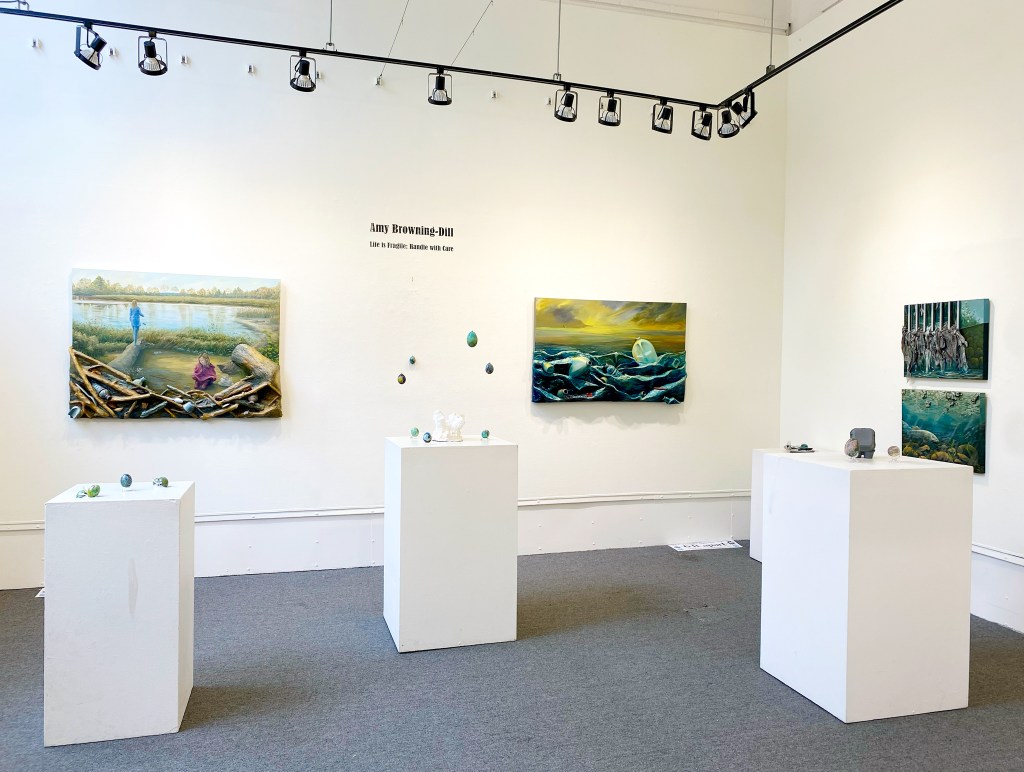
I dropped off the blogosphere during the last year and a half, but I’m back, and hopefully with more regular posts. After having been awarded a solo exhibit at the Art League Gallery in Alexandria, VA for April 2022, I spent all my spare time and energy since Autumn 2020 on creating works of art. Some of the pieces were large, mixed media paintings with sculptural elements (the largest measuring 40×48 inches) and others were delicately painted chicken and duck eggshells, of which I spent a minimum of 5 hours on each painting. The way I installed the exhibit turned out to be installation art in itself. The following is a documentation of my artist statement, a few samples of my work, and how I installed it in the gallery. In the coming weeks I will share more detailed accounts of my artistic process and inspiration for individual pieces.

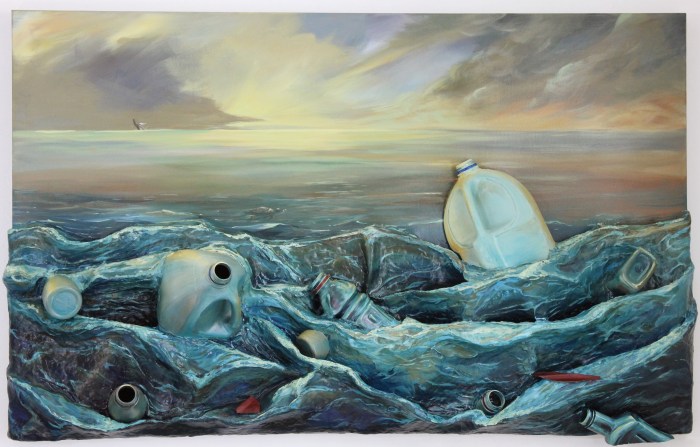
Sea of Plastic, 36×48 inches

The beauty and fragility of life on Earth is the inspiration for this series of paintings and assemblages. In Genesis God gave man a commandment, “Be fruitful, multiply and subdue the Earth.” “Subdue” in this context means to “bring under control”, but humanity has gone farther than bringing nature under control and, like a tyrant king, through greed and sloth, is destroying the very ecosystem in which he/she lives. In this exhibit I explore the ways in which human beings are connected to ecology: how we pollute the earth, destroy it, and how this destruction ultimately affects us. This series highlights the ugliness of that destruction juxtaposed with the beauty and fragility of the natural world.  

I have incorporated found objects, which would have otherwise been thrown away, into the large acrylics on canvas and board. Sometimes, in order to incorporate the objects into the piece, I sculpted the foreground out of wire and papier mâché and covered this in gesso and paint to make a transition between the 2- and 3-Dimensional portions of the artwork. Juxtaposed with these large, foreboding paintings are tiny, delicate eggshells painted with living creatures. There are a handful of eggshells that are intentionally broken, representing extinct or endangered life. In the paintings as well as on the eggshells you will find humans, there to represent our presence in the environment and the fragility of human life. Humans are stewards of creation, and the choices that we make not only affect the non-sentient life around us, but other human lives and the lives of the next generation as well. This series focuses on the destruction that greed and carelessness have on the ecosystem, but there are layers of meaning hidden within this tiny cosmos of paintings, waiting to be uncovered.

Above is a sampling of how I chose to exhibit the works. Photography, unfortunately, fails to exhibit how 3-Dimensional the artwork actually is. The works on canvas and board were hung traditionally, while at least half the number of eggshells were hung from wires strung across the ceiling. The centerpiece of one arrangement of coral reef life was a sculpture of bleached coral made from papier mâché, gesso and eggshells. The rest of the eggshells I displayed on egg stands set on pedestals.

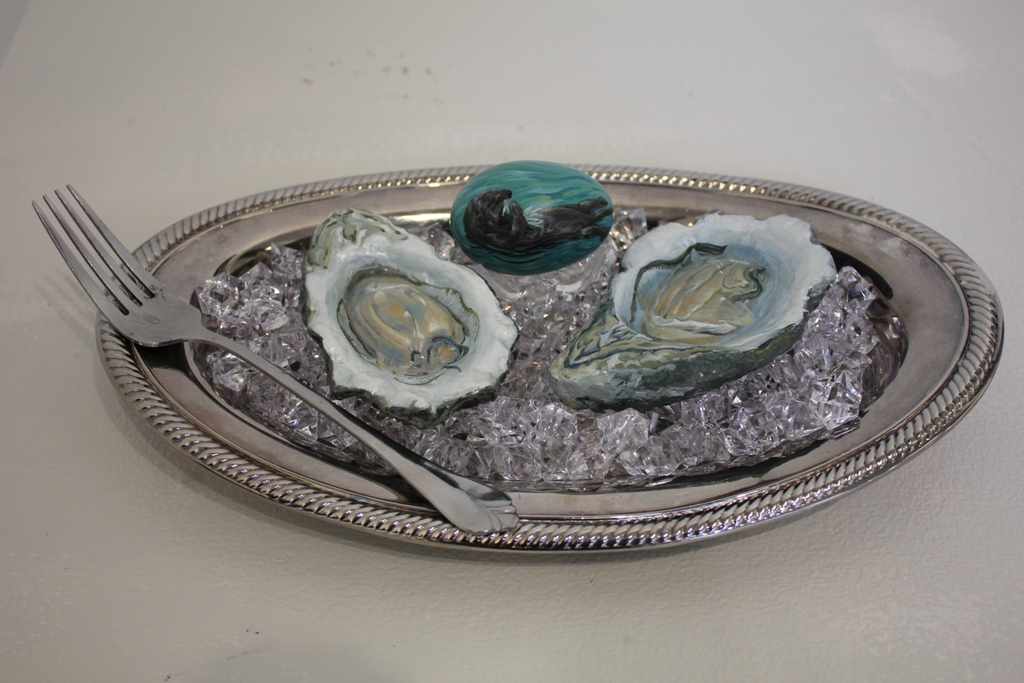
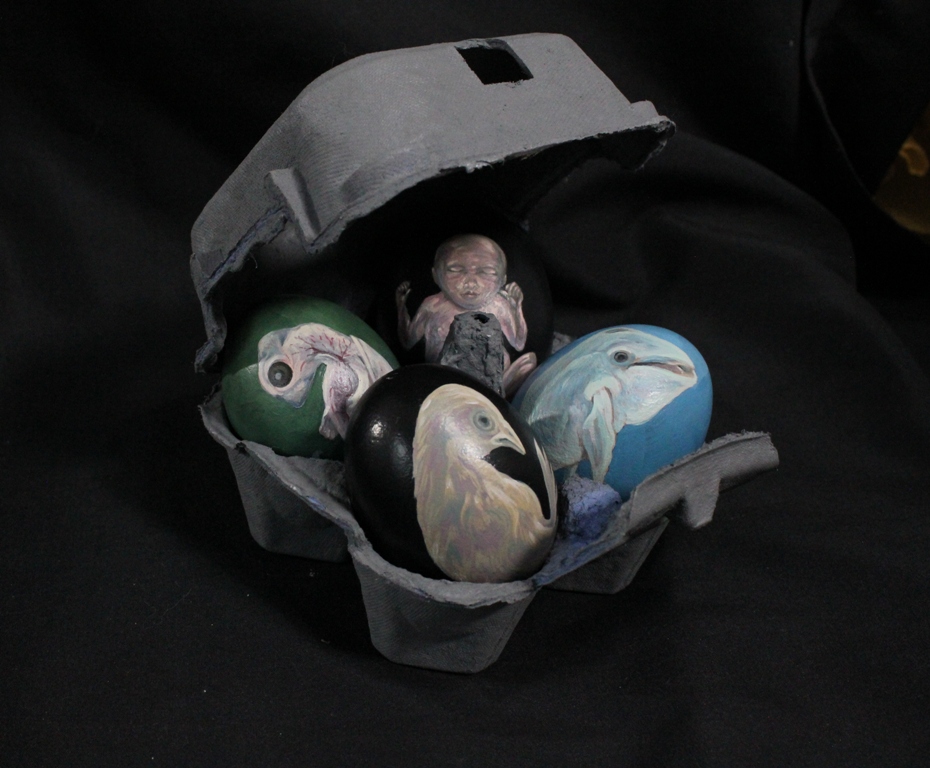
These are two of the arrangements that pull my artist statement together, which is that human life is as dependent upon and as fragile as the rest of the environment. The oysters in the sculpture/painting on the left were sculpted with wire, papier mâché, and gesso. This work represents the toxins that can enter food sources through improper water treatment, crop fertilization, or manure runoff. The egg carton on the right is symbolic of the safety and protection of the mother’s womb, but of which all sorts of toxins and threats can penetrate. I will write more about these works in the future.

If you wish to see more of these works, check out my portfolio page: https://amybrowningart.com/portfolio-2/life-is-fragile-handle-with-care/

In the Studio with Amy

This blog is to give you a little glimpse into my studio. I both paint and teach drawing and painting, so I will be sharing anything from the meanings behind selections of my work; tips and techniques that artists can use; projects for your children to do at home; and an occasional write up about an art exhibit you can visit. I hope many people who enjoy art can find something of value in my posts.